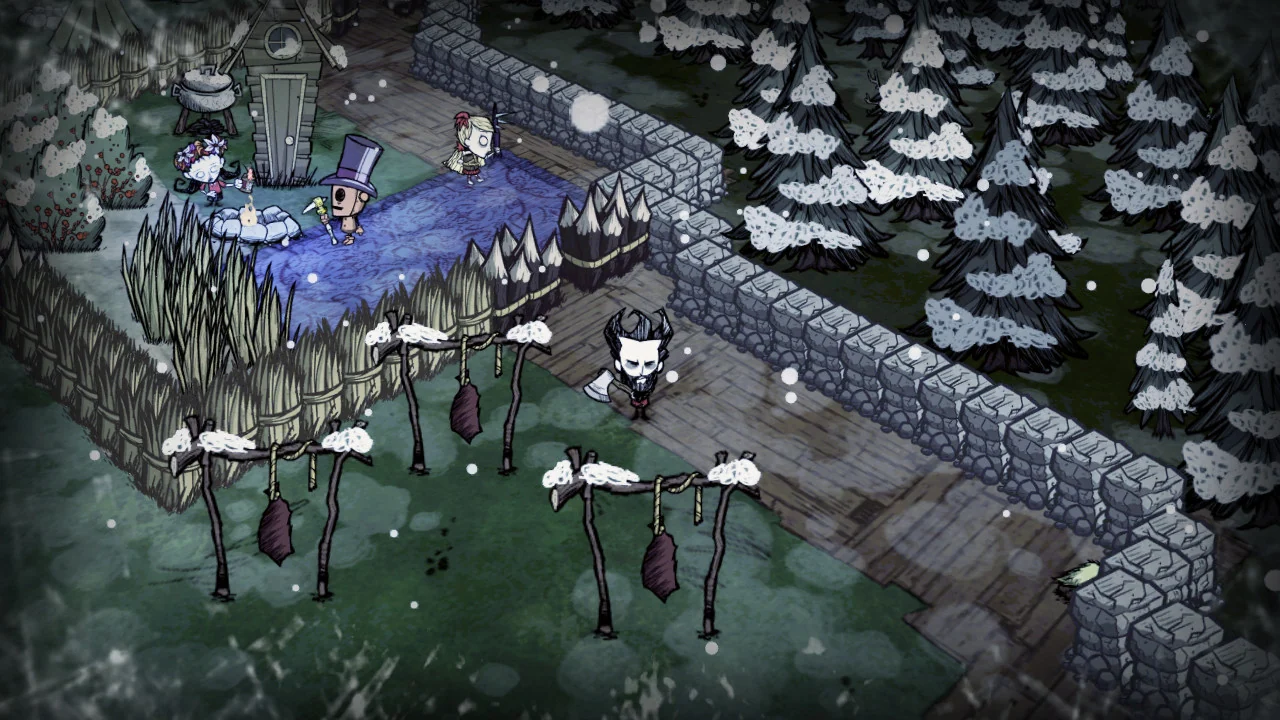
Many new players mostly treat ponds as a simple spot for fishing, but after putting many hours into different worlds, I’ve come to realize ponds are far more versatile. Different pond variants spawn in distinct biomes, each with unique creatures, resources and hidden mechanics. Some can even serve as stable food or material sources if you know how to use them properly. Below I break down every pond type, where you find them, what they offer, plus which characters work well alongside each one.
Regular Surface Ponds#
You will find regular ponds scattered across grassland and forest biomes on the surface world. These are frog‑spawning nests. Frogs hop out during daytime and retreat back into ponds once dusk arrives. You can catch freshwater fish here with a freshwater fishing rod.
Characters that pair nicely with regular ponds
- Wigfrid: Constant frog spawn means a steady supply of small meat for her carnivorous diet.
- Wormwood: Spoiled fish gained from fishing grants him bloom progress. You can also fill your watering can right at the pond for farm irrigation.
- Wendy: Abigail’s area‑of‑effect damage easily clears groups of frogs with little risk to Wendy herself.
One detail worth noting for Willow players: frogs count as permanently wet creatures. Killing them will not generate any ember for her skill tree, so do not rely on frogs to farm ember resources.
Mossy Caves Ponds#
Mossy ponds generate inside the caves, mostly around the ruins outer perimeter. They spawn eels instead of ordinary freshwater fish when you fish them. If you are short on gold early‑game, heading underground to these ponds is a solid option. Instead of pre‑crafting many fishing rods ahead of time, just bring stacks of twigs and silk. You can build new rods on‑site as old ones wear out. With good vision coverage you can fish out most of the local eel population. Eels can be cooked or turned into advanced recipes, and the loot cycle here can give you consistent gold income.
These underground ponds never freeze over in winter, which is also helpful if you need water sources during the cold season when surface ponds get locked by ice.
Hot Springs (Lunar Island)#
Hot springs appear on the Lunar Island bathing grounds biome. Even in their normal state they emit heat and can keep you warm nearby. Once you toss bath bombs in, the spring boils, giving off much stronger warmth. Boiling hot springs have extra benefits including sanity and health regeneration, though your equipped hand‑and‑body items will drop onto the ground while you bathe inside them.
Hot springs can also recharge watering‑can durability. On full‑moon nights boiling hot springs may turn crystalline; mining crystalline hot springs yields moon shards and occasional gems.
Oasis Lake#
The large oasis lake sits within the desert biome. It has hard‑capped natural spawn limits for its surrounding wildlife and plants. Succulents around the lake will respawn only up to a maximum of 18 units after you harvest them, so you cannot endlessly farm more succulents than this cap. Fireflies near the lake also have a hard cap of three spawns; they will not multiply past this number no matter how long you wait.
Unlike many surface ponds, oasis lake never freezes in winter, making it a reliable year‑round water source for your watering can.
Marsh Ponds#
Marsh ponds are located within swamp biomes. Instead of frogs, these ponds spawn mosquitoes that come out during dusk and night time, returning to water at dawn. Walter (Wortox’s sister) fits extremely well near marsh ponds. Her skill tree contains multiple mechanics that synergize with mosquitoes, making settling close to marsh ponds a viable base‑location choice for her playthroughs. Since mosquitoes are active mainly after sunset, you can avoid aggro by doing your fishing during broad daylight.
General practical notes for all ponds#
- Fish populations inside each pond have upper limits. Fishing speed slows noticeably once many fish have been pulled out. Move between multiple ponds and give them time to repopulate for better efficiency.
- Surface ponds freeze solid in winter. Frozen ponds cannot be fished from or used to fill watering cans, though you can safely walk across the ice surface.
- Each pond has a small number of decorative plants or algae growing around its edges, which can be burned for ash.
Water changes how everything paths#
Ponds are not only fishing spots; they are terrain. Hounds and most ground mobs route around water rather than through it, which makes a pond a free wall segment if your base already sits beside one. The mistake is building the wall and then leaving a single dry gap that turns the pond from an obstacle into a detour.
If you are choosing a base site, a pond on one side is a quiet advantage: it shortens the perimeter you have to wall and it gives you a water source for recipes and fire suppression without a bucket trip.
The pond you actually need is the one near your base#
Most players travel to a specific pond type once, collect what they came for, and never return. The pond that earns its place is the one within a short walk, because fishing is a filler activity — something you do while food cooks or a season turns over, not a destination.
That reframes the list above. Rather than picking the most interesting pond on the map, work out which of the five is closest to where you already spend time, and build the routine around that one.
When a pond becomes a liability#
Surface water near a base attracts frogs in spring, and a frog that wanders into your cooking area is a nuisance during the exact season you are busiest. Keep the pond at the edge of the base rather than in the middle of it, and keep the fire pit and drying racks away from the waterline.
The cave ponds are the opposite case: they are far from base by definition, so they are worth a dedicated trip with empty inventory space rather than an opportunistic stop.
One practical habit: keep a pond inside your base perimeter rather than outside it. Standing water is a fire-fighting tool and a recipe ingredient source, and a bucket trip during a base fire is time you do not have.
Cave ponds sit in permanent darkness, so bring light and do not fish there at low health — the trip is long enough that one bad night is expensive. And if you do build beside a pond, keep the fishing spot on the base side of the wall rather than outside it, so you are never standing in the open with your inventory full.
Closing thoughts#
Ponds are easy to overlook early‑game when you are busy gathering basic twigs and flint. Once you understand each variant’s rules, they become convenient sources of food, water, cooking ingredients and even gold. Depending on which character you pick, certain pond types can drastically smooth out your early‑to‑mid‑game progression. When scouting for potential base spots, it is always worth checking nearby pond types before you place your camp.
Ponds matter most when food does: the crock pot guide explains which fish are worth keeping, and the hound guide covers the nights when standing near water is the wrong idea.